By Emma Verhagen, CEO Ideal Shift AI · 30 June 2026 · Reading time: 5 minutes
Everyone wants "something with AI". Almost nobody talks about data
Every week I speak with executives, IT people and clinicians in healthcare. Everyone wants "something with AI". Almost nobody talks about the one thing that determines whether that AI will ever work: data.
That is what I want to talk about today. In plain language, no jargon and no hype.
The real problem is not too little data. It is too much data, in too many places
A clinician sometimes retypes the same information three times over. Once in the EHR, once in an email, once in another system. One client's data sits scattered across the EHR, Outlook, Karify, Minddistrict and a handful of loose files.
Nothing talks to anything else. So valuable time, time that should have gone to the client, goes to administration and retyping instead.
Before you even think about AI, you have to solve this. Because AI on messy data produces messy output. Guaranteed.
The first law of data work: a single source of truth
Pick one system that leads. In healthcare that is usually the EHR. Everything created somewhere else, an email, a message, a form, gets written back to that one source as fast as possible, in exactly the right format.
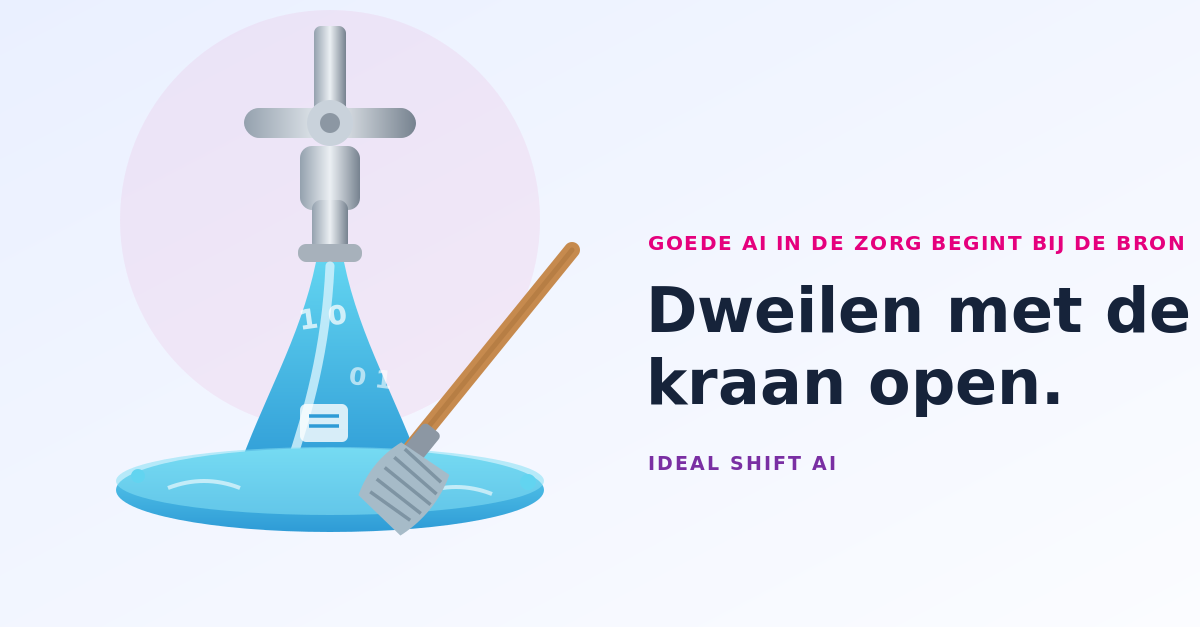
If you do not, you are mopping with the tap running. You keep correcting after the fact, endlessly, because the source is never right.
It sounds simple. It is the foundation almost everything else rests on.
Two words you will hear more often: FHIR and openEHR
No panic, I will keep this short.
FHIR is the language healthcare systems use to talk to each other. It handles the exchange: system A asks for a medication overview, system B delivers it, quickly, in a standardised way and in real time.
openEHR is about how you store data so that it still carries meaning twenty years from now, whatever software you are using by then. It makes the record future-proof and decoupled from any single vendor.
It is not either/or. It is both: FHIR for the traffic, openEHR for durable storage.
Why does this matter to you as a healthcare professional? One sentence: it is how your data stays yours, rather than your software vendor's.
A secret from an entirely different world
Before I worked in healthcare I led data transformations in manufacturing, at Unilever, across 21 programmes and 190 countries. On data, that sector is years ahead of healthcare. And the most important lesson is surprisingly simple: work with two layers.
The two data layers
- Layer 1, "As Is": all data from every system, stored exactly as it arrives. Raw and unfiltered.
- Layer 2, "Core": that same data, cleaned up and converted to recognised standards such as FHIR and openEHR, ready for analysis and AI.
Raw data and clean data kept strictly separate. Nothing is lost, and you can always go back to the source. Healthcare can adopt this approach today.
And the AI? Do not start by boiling the ocean
This is where it usually goes wrong. An organisation decides to migrate and standardise all its data first, a project of a year or more. A great deal happens under the bonnet, but nobody sees a result. Support evaporates and the project dies quietly.
Do it the other way round. Start with one use case that carries hard value.
A concrete example we have already built: automatically registering asynchronous care, meaning email contact and digital interactions with clients. Less administration, better records and fewer missed billable activities.
The business case? For an organisation with around 250 clinicians it quickly adds up to a value in the order of 1.5 to 2 million euro per year. And it needs only a few tables out of the EHR. Small project, large result.
Once people see that value, trust appears. And from trust you scale, use case by use case. Not the other way round.
Privacy is not a brake. It is a design choice
"But what about GDPR?" A fair question. The answer is: build privacy in from the start.
Work with pseudonymisation and anonymisation, rule out the risk of re-identification as far as possible, and host AI models internally, inside your own environment, so sensitive data never leaves the organisation. Then you can reuse data responsibly, for instance for wider European research under the European Health Data Space (EHDS).
Good privacy and good AI are not opposites. They come out of the same considered architecture.
The plan, in three phases
- Phase 1, prove the value. Start with one concrete use case that pays for itself, such as automatically registering asynchronous care. Small, fast and visible. That is how you build trust and support.
- Phase 2, expand. Add use case after use case, partly reusable solutions and partly bespoke ones. The platform grows organically alongside the value it delivers.
- Phase 3, scale and secure. Standardise at scale (FHIR, openEHR), get privacy and governance right, and make the architecture ready for what is coming, such as secure data exchange under the European Health Data Space (EHDS).
The core of it, in four sentences
- AI in healthcare rarely fails because of the AI. It fails because the data is not in order.
- Pick a single source of truth and fix it at the source, or you are mopping with the tap running.
- Build on open standards, so your data stays yours.
- Start small, deliver visible value and scale from there.
In the end this is not a technology story. It is a care story: less time on administration, more time for the client.
Do you work in healthcare and recognise this? I am glad to think it through with you. Send me a message and I will happily share our approach.